

When Intelligence Redefines Itself

Companies delivered a layoff shock; for many, past performance didn’t matter for the layoff. The fear isn’t job loss, but the shifting definition of intelligence. Skills that were once highly rated on the curve are now automated, augmented, or rendered irrelevant. When criteria shift faster than cycles adapt, even consistent performers feel exposed. Starting from 3500 BCE with the invention of the wheel, the world witnessed inventions and technologies that improved our lives, day after day. We architected, built and sourced intelligence, but now intelligence is a challenge for us.
What’s changing?
The universe is in a continuous state of flux, transforming every day without pause. The transformation is infinite, from fire signals to the telegraph to satellites; every medium reshaped the way we connected. Whether it was an email, a text message, or a streaming video, ones and zeros are racing across fibre, satellites, and wireless networks. A message could cross oceans, leap between devices and people. Millennials witnessed the web’s debut, Gen Z grew up using smartphones; Gen Alpha enters a domain where intelligence is everywhere. The intelligence that defined the solutions has redefined itself. When mechanisation reshaped industries in the 18th century, manual craftsmanship began shifting to autonomous systems, and three centuries later, the journey has led us to Artificial Intelligence. AI opened the door to a plethora of experiences — simulating human learning, comprehension, problem-solving, decision-making, creativity, and autonomy. The boundaries between humans and machines are softening as artificial intelligence listens, interprets, and even speaks on our behalf. Our quest to thrive and innovate is rigid, procedural and inevitable; and that’s how we built the AI system. And yet, by creating AI, we built something that challenges us with its mastery, compressing hours into seconds and shifting the threshold of what is intelligent work.
Is there a problem?
When machines exceed intelligence, what becomes of the people who once embodied it? The 2025 layoffs were not random events—they were signs of an accelerating shift. Industrialisation took decades to alter economies; computers took years to enter offices, but AI stole the show in a short span. The issue resides in the rate of AI adaptation alongside its task completion. Workers are not just losing jobs; they are losing confidence in their relevance. Your valuable skill set that took years to master is one click away from your manager. Just as computers absorbed jobs, AI will absorb your work. The traditional tradeoff between your skill and paycheck is an old story, because human intelligence can’t survive against faster AI systems. AI now performs the middle-layer work, whether it’s a draft or a report, leading to the departments once busy with specialists being trimmed into lean teams. The work rhythm changed; what took weeks is done in hours. Intelligence automates itself and questions our unique value.
How to tackle?
Change is the only constant, as quoted by Heraclitus, “You cannot step into the same river twice”; so we can’t pause the transformation. Inventions replaced specific roles while generating fresh ones. The industrial age demanded new skills in engineering, and the digital age rewarded those who could code and connect. The age of AI calls for a shift in posture. Resisting yourself against AI will pull you back from the race, learn how to live with AI, how to use AI and reimagine the boundaries of our own intelligence. The transition will be difficult; nevertheless, we must acknowledge and adapt to AI to reposition ourselves in relation to it. AI is not a replacement for human intelligence; it extends perennial intelligence that has carried us from fire signals to here.
What’s next?
Future AI solutions will accomplish much more than answering inquiries. The definition of intelligence will stretch again, moving from problem-solving into realms of presence, intuition, and shared cognition. Just as mechanisation amplified physical strength and computers extended memory and logic, AI will extend judgment, creativity, and perception. Together, AI and Human Intelligence will collaborate, despite being in a healthy contest; our role will shift from execution to orchestration.
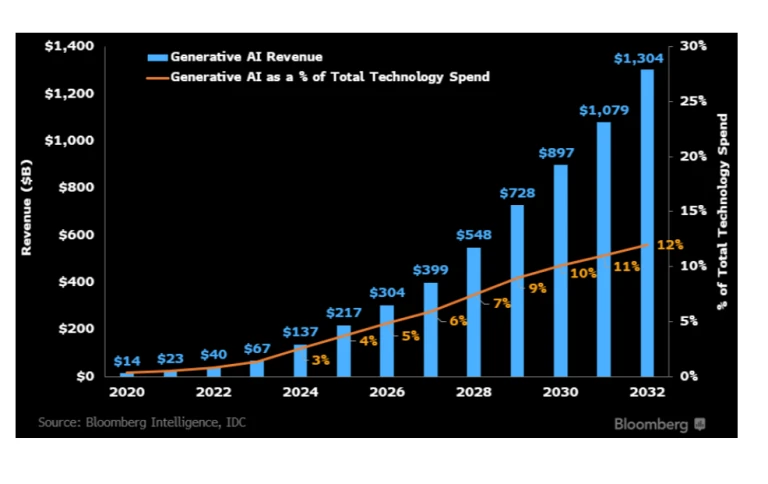
Bloomberg projects Generative AI to grow into a $1.3 trillion market by 2032. AI is the new gold rush — you can dig for the gold or sell the shovels. Either way, the opportunity is real. And even if winning feels out of reach, staying in the game matters, because those who step aside risk seeing their performance milestones gather dust on the shelf!!
Intelligence is the ability to adapt to change
~ Stephen Hawking (unverified internet claim)
Comments
Join the discussionNo comments yet. Be the first to comment.


